

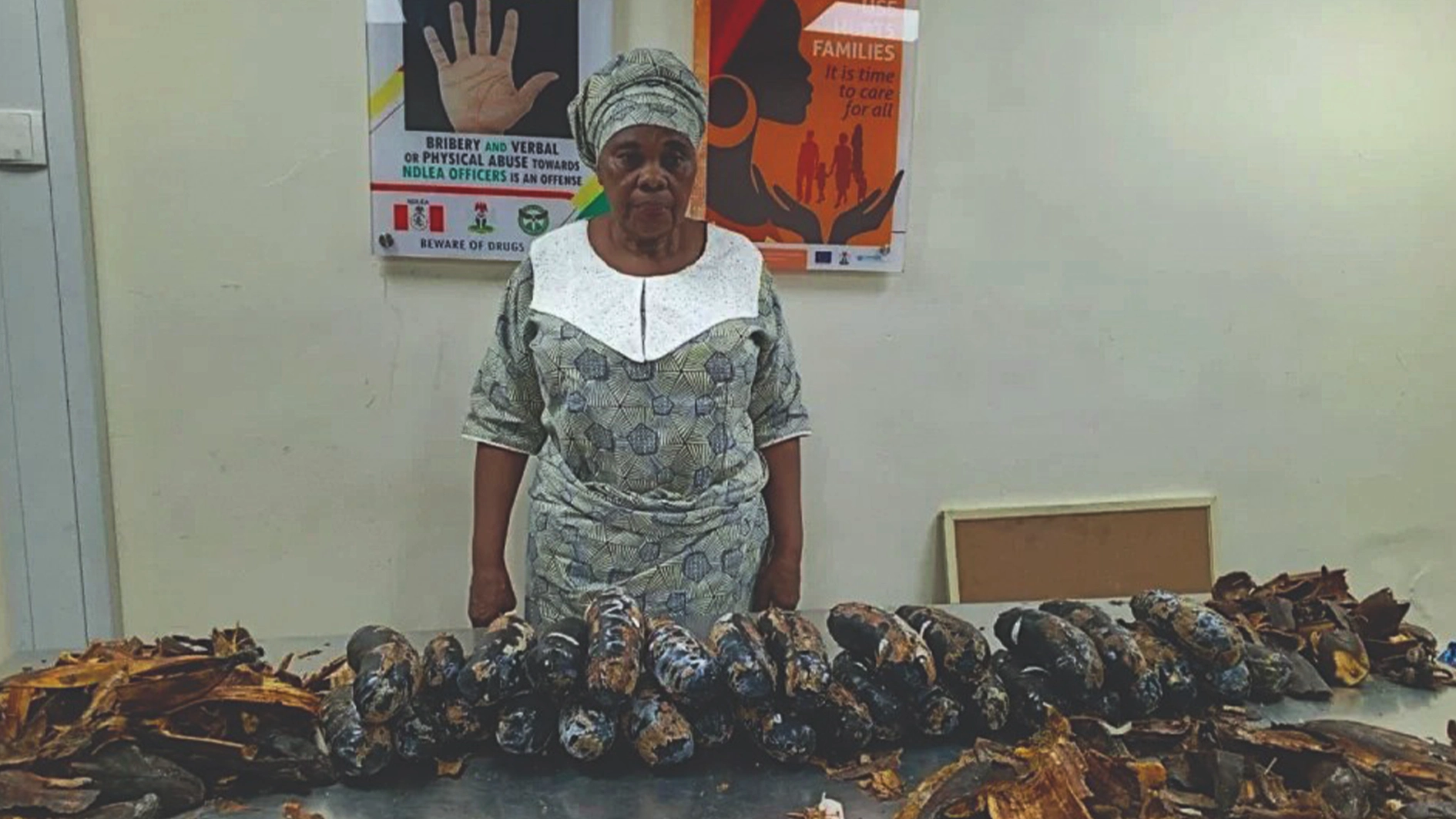
The growing arrest of Nigerians aged 60 and above for drug-related offences is raising concerns over the changing face of illicit drug trafficking in the country. In this report, MOYOSORE SALAMI examines why elderly Nigerians are attracted to drug trade and what could be done to curb the trend.
Nigeria is facing a disturbing increase in the arrest of elderly people for drug-related offences, with suspects aged 60 and above being caught with cannabis, tramadol and large consignments of cocaine. While some appear to have been drawn into the illicit trade by financial difficulties, others have been linked to drug networks as couriers, dealers or custodians of illegal substances.
In March 2026, a 74-year-old man was arrested at the departure hall of the Nnamdi Azikiwe International Airport, Abuja, while allegedly attempting to smuggle 11 kilogrammes of cocaine to the United Kingdom.
The septuagenarian was arrested while attempting to board British Airways flight BA082, bound for Heathrow, London, on Saturday, March 14, 2026.
Disclosing this in a statement, NDLEA spokesman, Femi Babafemi, said a search of the suspect’s luggage revealed blocks of cocaine concealed inside food items, including ground dry pepper.
He said the cocaine, weighing 11 kilogrammes, was carefully wrapped in foil papers and balloons before being hidden among the food items.
Babafemi noted that the suspect claimed he was travelling to London for vacation.
The case is not an isolated oneinvolving an elderly Nigerian at an airport.
A 67-year-old Nigerian-British grandmother, Mary Yetunde Barek, was arrested by NDLEA operatives at the Murtala Muhammed International Airport, Ikeja, Lagos, after 13 kilogrammes of cocaine were allegedly discovered in her luggage.
Barek, who works as a caregiver in the United Kingdom, was arrested at the departure hall of Terminal 2 while attempting to board a Virgin Atlantic flight to London on Sunday, June 28, 2026.
A search of her luggage reportedly led to the discovery of 31 large wraps of cocaine packaged to resemble bunches of plantain and weighing 13 kilogrammes. The elderly woman later admitted ownership of the seized cocaine, according to the agency.
While the two airport arrests involved elderly people allegedly transporting large quantities of cocaine outside the country, another case involving a 101-year-old woman showed that older Nigerians are also appearing in local drug-dealing cases.
On August 15, 2026, NDLEA operatives arrested Esther Ogunmabo, a 101-year-old great-grandmother, in Ilisan, Ogun State, with 90 grammes of skunk, a strain of cannabis, packaged in retail sachets. The centenarian reportedly told operatives that she sold the substance to people in her community.
Ogunmabo said she resorted to the illicit drug trade after her provisions shop was razed by fire. She added that one of her daughters, who resides in Lagos, supplied the substance to her every four days, which she sold in bits.
Following her arrest, the NDLEA Chairman/Chief Executive Officer, Brig. Gen. Mohamed Buba Marwa (rtd), directed that the suspect be granted bail and placed on counselling because of her advanced age.
The cases have brought attention to the involvement of elderly Nigerians in the country’s illicit drug market and the circumstances that may be pushing some of them into the trade.
For some, the reason may be financial hardship. Unlike younger Nigerians who may be able to engage in physically demanding jobs or move from one job to another, many elderly people depend on pensions, small businesses, family support or informal activities for survival.
The loss of a source of income can therefore leave them particularly vulnerable. Ogunmabo’s explanation that she entered the drug trade after losing her provisions shop to fire is one example.
But poverty alone may not explain the growing number of elderly people appearing in drug cases. The arrest of a visually impaired 67-year-old man, Aliyu Adebiyi, in Osun State also points to the role of drug dealers who use vulnerable people to store illicit substances.
Adebiyi of Sokoto Village, Owena Ijesa, Atakumosa East Council of Osun State, was taken into custody by NDLEA operatives on January 20 after 234 kilogrammes of Indian hemp were allegedly found in his house.
In his statement, he reportedly said a drug dealer kept the consignment with him for a fee of N6,000 per month and paid him for three months upfront.
The case reveals how drug dealers recruit elderly people and whether some older suspects are knowingly participating in trafficking or are being exploited because of their economic circumstances.
The illicit drug trade remains a lucrative business in Nigeria, with large quantities of cannabis, cocaine, tramadol and other controlled substances being moved through communities, ports, airports and international borders.
The NDLEA has in recent years intensified its operations against traffickers and dealers across the country.
In one of its operations, the agency intercepted 1,645,560 pills of Tramadol in 100mg, 200mg and 225mg strengths at a warehouse in Greenfield Estate, Amuwo Odofin, Lagos. Another 60,000 pills of 250mg Tramadol were recovered from a wanted drug dealer, Diugwu Alphonsus, in Bariga, Lagos. Raids in the Akala area of Mushin also led to the recovery of 781.7 kilogrammes of Indian hemp.
The scale of such seizures shows the size of the market in which elderly Nigerians are increasingly being found as dealers, couriers or people allegedly keeping drugs for others.
The use of elderly people may also be linked to the belief among traffickers that they are less likely to attract suspicion.
A young person traveling with a large quantity of food items or moving repeatedly through an airport may attract attention from security operatives. An elderly traveler, particularly one appearing to be traveling for family or holiday purposes, may be perceived differently.
This could make older people useful to criminal networks seeking couriers for international routes. The 74-year-old man arrested in Abuja and the 67-year-old grandmother arrested in Lagos were both allegedly travelling to the United Kingdom when they were intercepted.
In both cases, cocaine was concealed in ordinary-looking items in their luggage.
The cases also show that the involvement of elderly people in the drug trade is not limited to street-level dealing. Some are allegedly involved in international trafficking, where large quantities of drugs are moved across borders.
Others are accused of selling drugs locally, while some may provide storage facilities for established dealers. The different roles suggest that elderly people may be entering the illicit trade through different routes.
For some, it may be the need for money. For others, it could be family influence, recruitment by criminal networks or the expectation that their age would make them less suspicious.
The role of family members is particularly concerning in Ogunmabo’s case, where she reportedly identified her daughter as the person supplying her with cannabis.
This indicates that older people can also become involved in drug dealing through existing family relationships. The involvement of elderly Nigerians also suggests the effectiveness of existing social protection measures for older people.
Where an elderly person loses a source of income has no adequate pension or is unable to meet basic household needs, the absence of support can create room for exploitation by criminal networks.
Experts have, therefore, called for greater attention to the economic conditions of elderly Nigerians, particularly those who have no reliable source of income.
However, economic hardship should not be used to excuse deliberate involvement in drug trafficking. The 13 kilogrammes of cocaine allegedly found in Barek’s luggage and the 11 kilogrammes allegedly recovered from the 74-year-old man’s luggage are far beyond what could reasonably be described as casual possession.
Such cases point to the need for law enforcement agencies to continue tracking the networks behind the couriers and dealers.
The NDLEA’s operations have resulted in the arrest of numerous suspects and the seizure of large quantities of illicit substances, but the emergence of elderly suspects presents another challenge for the agency.
Security agencies must be able to identify traffickers regardless of age while also determining whether vulnerable older people are being used by more powerful criminal networks.
The case of Adebiyi, who reportedly said he was paid N6,000 monthly to keep 234 kilogrammes of Indian hemp, shows why investigations should not end with the person found in possession of the drugs.
The person who supplied the drugs, paid the elderly man and controlled the consignment may remain outside the reach of the law if investigations focus only on the person physically caught with the substance.
There is also a need for public awareness among elderly people about the tactics used by drug traffickers.
Older people who are offered money to carry packages, keep bags or allow their homes to be used for storage need to understand that they may be exposing themselves to serious criminal charges.
Family members also have a role to play by providing support for elderly relatives facing financial difficulties rather than allowing them to become dependent on criminal activities.
The increasing arrest of Nigerians aged 60 and above for drug-related offences is a reminder that the country’s drug problem is affecting people across age groups.
At least 30 Nigerians aged between 60 and 101 were arrested in drug-related cases in the last one year, according to an assessment by Beacon Security and Innovations Limited (BSIL), raising concerns that organised drug networks may be deliberately recruiting older people to evade law enforcement profiling.
Managing Director of BSIL and security risk management and intelligence expert in Nigeria and the Sahel region, Dr Kabir Adamu, said a review of the company’s incident log of National Drug Law Enforcement Agency (NDLEA) reports showed that the figure rises further when suspects in their 50s are included.
Adamu said the development pointed to a systemic pattern rather than a series of isolated incidents.
According to him, the cases show that elderly Nigerians are increasingly appearing at different levels of the drug trade, from street-level retailing and courier activities to storage, financing and, in some cases, alleged leadership of major trafficking networks.
He said the individual cases had given a human face to the statistics. “In August, operatives arrested a 101-year-old great-grandmother in Ogun State for allegedly retailing cannabis in sachets to her community, in the same nationwide sweep that intercepted cocaine hidden inside cassava fufu and seized more than a tonne of high-grade cannabis shipped in through Lagos ports.
“Months earlier, an 80-year-old man was picked up in Ekiti State with skunk and methamphetamine, in an operation that, in the same breath, uncovered nearly a tonne of the same substance elsewhere and a separate cocaine consignment concealed in stockfish destined for export.
“And it is not only couriers and retailers: a 63-year-old businessman was arraigned this year as the alleged financier and coordinator behind a Nigerian-Mexican methamphetamine ‘super-lab’ in Ogun State, one of the largest synthetic drug operations uncovered in the country’s history, working alongside foreign chemists brought in specifically for their technical expertise.”
Adamu noted that, taken together, the cases showed elderly Nigerians occupying “nearly every rung of the trafficking ladder”, including couriers, street-level retailers, storage-house keepers and financiers, as well as alleged leadership roles in transnational operations.
He explained that though economic hardship could have pushed some older people into the trade, the wider pattern suggested a deliberate adaptation by trafficking networks following intensified enforcement.
“The pattern goes beyond individual desperation in old age,” he said, adding though economic hardship undoubtedly plays a part for some, “It is more significantly evidence of a deliberate and calculated adaptation by trafficking networks in response to years of intensified enforcement,” he said
According to the security expert, one reason organised drug networks may be turning to older Nigerians is the assumption that they are less likely to attract suspicion from law enforcement.
He said trafficking organisations understood that security profiling had traditionally focused on younger and middle-aged men and could therefore recruit people outside that profile.
“An elderly man or woman moving through an airport, a border post, or a local market attracts less scrutiny,” Adamu explained.
He also pointed to what he described as a shift from the use of ad-hoc drug mules to more structured, multi-role networks.
According to him, the different roles now allegedly occupied by elderly suspects suggest that their involvement cannot always be dismissed as isolated recruitment of vulnerable individuals.
“The range of roles elderly suspects now occupy, from a grandmother selling sachets locally to a sexagenarian allegedly running a bi-national meth syndicate, suggests these are not one-off recruitments of vulnerable individuals, but calculated insertions into different tiers of otherwise well-organised networks: local distribution, storage and logistics, and, in rarer but more consequential cases, financing and command,” he said.
Adamu further linked the development to Nigeria’s evolving position in the international drug trade, citing the scale of recent seizures, the production of synthetic drugs locally and the emergence of sophisticated trafficking routes.
He said the production of methamphetamine in industrial quantities, including cases involving foreign technical expertise, as well as large cannabis shipments arriving through maritime routes, pointed to a more complex drug-trafficking environment.
“This evolution requires more sophisticated concealment methods, wider and more diverse recruitment pools, and closer coordination with foreign cartels, all of which create more entry points, including for older recruits,” he said.
He added that the development was not peculiar to Nigeria, saying BSIL’s monitoring of the Sahel and wider West African region had identified similar cases involving elderly suspects.
According to him, arrests involving people in their late 60s and 70s in neighbouring countries suggested that trafficking networks operating across porous borders and informal maritime routes were applying similar recruitment strategies across the region.
On the implications for national security, Adamu said security agencies needed to review existing profiling and screening procedures at airports, borders and checkpoints to ensure older travellers and traders were not automatically considered low-risk.
“Profiling and screening protocols at ports, borders and checkpoints need to be broadened so that older travellers and traders are not implicitly waved through,” he said.
He also stressed the importance of community-level intelligence gathering, noting that elderly retailers could be deeply embedded within the communities where they operate.
“Community-level intelligence gathering matters more than ever, since elderly retailers are often deeply embedded in the very communities enforcement agencies rely on for tips,” he explained.
However, Adamu cautioned against treating all elderly suspects in the same way, arguing that security and justice responses should consider the difference between vulnerable individuals and those allegedly occupying senior positions within trafficking organisations.
“Prosecutorial and rehabilitative responses need to distinguish between elderly individuals coerced or economically pressured into low-level roles and those knowingly occupying positions of leadership and financing within these networks,” he said.
“A one-size-fits-all response risks either excessive leniency for kingpins or excessive harshness toward genuinely vulnerable people.”
Adamu concluded that the increasing involvement of older Nigerians in drug trafficking should be understood as evidence of both progress and gaps in Nigeria’s fight against organised drug crime.
“Ultimately, this ‘greying’ of Nigeria’s drug trade is best read as a symptom of success and failure occurring simultaneously: enforcement has become effective enough to force networks to adapt their tactics, but those networks are adapting faster than the profiling and intelligence frameworks meant to catch them.
“Closing that gap will require security agencies to treat this not as an anomaly, but as the new operating pattern of organised drug trafficking in Nigeria,” he said.
Professor of Criminology, Adedeji Oyenuga, has attributed the increasing involvement of older Nigerians in drug trafficking to a combination of poverty and the tendency of security agencies to pay less attention to elderly people during crime detection and screening.
Oyenuga, who is also a practising investigator, said his experience had shown that older people were often overlooked when law enforcement agencies considered potential perpetrators of crime.
He said, “Yes, like you, I also realise that we have a lot of cases where older people have been involved in the peddling of drugs, locally and internationally.
“And I think I have a different point of view, in a way, and I’ll explain why I think so. Aside from being a criminologist, I’m also a practising investigator, and for many years I have observed that across the world, people pay less attention to older people. In terms of crime perpetration, they pay less attention to older people.”
According to him, beyond the perceived low-risk profile of older people, poverty was another factor that could make them vulnerable to recruitment by criminal networks.
He explained that financial security often became uncertain after retirement, particularly for people who had limited savings or inadequate income in old age.
“And that factor is poverty. Now, no matter how much money you made while you were younger, I’m not sure it’s going to be enough for you after 60, till the time you are going to die. So, financial security is no longer there for a lot of older people, 60 years and above,” he said.
Oyenuga stressed that poverty did not automatically turn people into criminals, but could place them in circumstances where resisting criminal opportunities became more difficult.
“Personally, I don’t always say that poverty is a factor for people’s involvement in crime. But I say that poverty puts them in a condition where it is difficult for them to resist temptation,” he said.
He noted that a retired person facing an uncertain future could be more receptive to an offer from a criminal network, particularly where the recruiters promised protection and companionship.
“So, in the same vein, a man 60 years and above who has retired is no longer working and it’s looking like the future is getting bleaker. The man would definitely grab such an opportunity when they give him the impression that, ‘We’re also going to be there to protect you. Don’t worry, you’re not alone. ‘We have insiders that are going to be there for you too.”
The criminologist said the perceived vulnerability of older people could also be an advantage for drug networks because they were less likely to be searched or subjected to the same level of scrutiny as younger suspects.
He said, “They do not consider them a threat. So, if you ask me, I would say that the instances that we have observed, the drug dealers considered the older people because maybe their condition and then their age would have been an advantage.
“Those who want to search, we search them less, we pay less attention to them, and it means that as a courier, they are likely to escape our security more easily than the younger people.”
Oyenuga recalled similar instances outside Nigeria where older people had allegedly been exploited by criminals because of the reduced suspicion they attracted.
He said the use of elderly people in financial crimes in the United States illustrated how criminal networks could exploit age and perceived respectability to evade security scrutiny.
He added that this made it possible for older people to be considered for criminal activities because security personnel might be more inclined to assist them than subject them to extensive searches.
Oyenuga cautioned against assuming that every older person involved in drug trafficking had been recruited because of poverty or vulnerability.
He explained that some elderly suspects could have been involved in the drug trade for decades and continued operating as they grew older.
“Sales of drugs is an old business and it’s possible for there to be some of you who started at a younger age and had grown in that system, had grown on the job and today he’s probably made all of his money from that drug and the business is still running,” he said.
According to him, older people involved in drug trafficking could therefore fall into different categories: those who had been in the trade for years, those recruited because of their economic circumstances, and others seeking to maintain a particular lifestyle despite an uncertain financial future.
“So we probably have older people who have been on the job for long and then we also have older people who, because of their condition, were convinced to use it as an alternative way of making money.
“And then others might probably be those that are in poverty, those that are poor, the future is not guaranteed and they need to keep up with a certain lifestyle, so they can also be there too,” he explained.
He described some of the long-standing participants as “old soldiers” who had remained active in the illicit trade despite their age.
“But we have older people that we can call old soldiers that have been involved in the sale and trafficking of drugs that are still involved in that particular job. So it’s possible,” he said.
Oyenuga further warned that criminal organisations continuously monitor changes in law enforcement strategies and adjust their operations to exploit security gaps.
“I tell people that the criminal networks also pay attention to policies, and observe as much as the law enforcement are also observing. And they always have a round table where they take decisions on the new dimensions that they must take in order for them to be able to achieve their goals more easily,” he said.
He suggested that the movement from recruiting mainly younger adults to involving older people could represent a deliberate strategy adopted by criminal networks after identifying gaps in security profiling.
“Now that tells us that moving from adults to older people was a policy that probably worked for some time. You know, we have not found a person arrested until very recently. But it does not mean that there have not been older people who have trafficked drugs beyond the shores of Nigeria before.
“It’s just that we are catching the first set now. And catching one paved the way for catching others. We don’t have to collect intelligence, we already know that the direction has changed.”
He said the development demonstrated the need for security agencies to continually anticipate how criminal networks could exploit weaknesses in existing enforcement strategies.
“Criminals are always working. Criminals are always looking for how to take advantage of the lapses, loopholes in security in order for them to achieve their goals. So, it does not mean that they are done working,” Oyenuga said.
He added that while crime could not be completely eliminated from society, the government had a responsibility to ensure that it was effectively controlled.
“They will keep working because I always tell people that there is nothing like a society of saints. There will always be crime. But then what matters to the government and to the people is that we must ensure that we control the crime as much as expected,” he said.
A lecturer in the Department of Sociology and Criminology, Fountain University, Osogbo, Ibrahim Bidemi Abdullateef, said the involvement of some older Nigerians in illegal activities, including drug trading, to poverty, inadequate social protection, unemployment and weak family support.
Abdullateef explained that older Nigerians could become vulnerable when they experience declining health, financial difficulties or dependence on others, particularly when legitimate economic opportunities become limited.
He said, “From a sociological perspective, older Nigerians may become vulnerable when they experience poverty, inadequate social security, unemployment, declining health, or dependence on others. Some may also face exclusion from economic opportunities because of their age.
“When these conditions are combined with weak family support and limited access to welfare services, illegal activities such as drug trading may become, to some individuals, a perceived means of survival or financial independence.”
According to him, such a transition should not necessarily be viewed as a sudden change in an individual’s morality, as changing social and economic circumstances could push people who had previously lived within the law towards illegal sources of income.
“I think such a transition is often connected to changing circumstances rather than simply a change in personal morality,” he said.
“An individual who has worked legitimately for decades may encounter sudden financial difficulties, business failure, debt, family responsibilities or loss of employment. If legitimate opportunities become unavailable, desperation can create pressure to consider illegal income-generating activities.
“At that point, survival concerns may outweigh previously held moral or social restraints.”
The sociologist also identified retirement as a potential source of financial vulnerability for older people, particularly where pension payments are inadequate, delayed or inconsistent.
He noted that retirees with medical expenses, dependents and other financial responsibilities could face significant economic pressure following the loss of regular income.
“Retirement can significantly reduce an individual’s regular income, particularly when pension payments are inadequate, delayed or inconsistent. For older people with medical expenses, dependants and other financial responsibilities, this reduction can create serious economic pressure,” Abdullateef explained.
He added that where social protection mechanisms were weak, some retirees might be forced to seek alternative sources of income, potentially exposing vulnerable individuals to illegal economic activities, including the drug trade.
However, Abdullateef stressed that financial hardship was only one factor that could explain why some older people become involved in crime.
He said loneliness, rejection, loss of authority and reduced social recognition could also affect older people, particularly after retirement or bereavement.
“Older people can experience loneliness, rejection, loss of authority and reduced social recognition after retirement or bereavement. These experiences may create feelings of frustration and worthlessness.
“In some circumstances, criminal networks can provide companionship, recognition or a sense of belonging. Therefore, involvement in crime may sometimes reflect not only the search for money but also the search for social connection, relevance and identity,” he said.
Abdullateef therefore called for a preventive and multidimensional approach to addressing the vulnerability of older Nigerians.
He urged the government to strengthen pension administration, social protection, healthcare and livelihood support for older people, while encouraging families to maintain meaningful social and emotional connections with elderly relatives.
“The response should be preventive and multidimensional. The government needs to strengthen pension administration, social protection, healthcare and livelihood support for older people.
“Families should maintain meaningful social and emotional connections with elderly relatives rather than focusing only on financial assistance. Communities can provide social networks and community-based support programmes.
“Most importantly, older people should be treated as active members of society whose dignity, economic security and social inclusion must be protected,” he said.
Original Source: The Guardian