

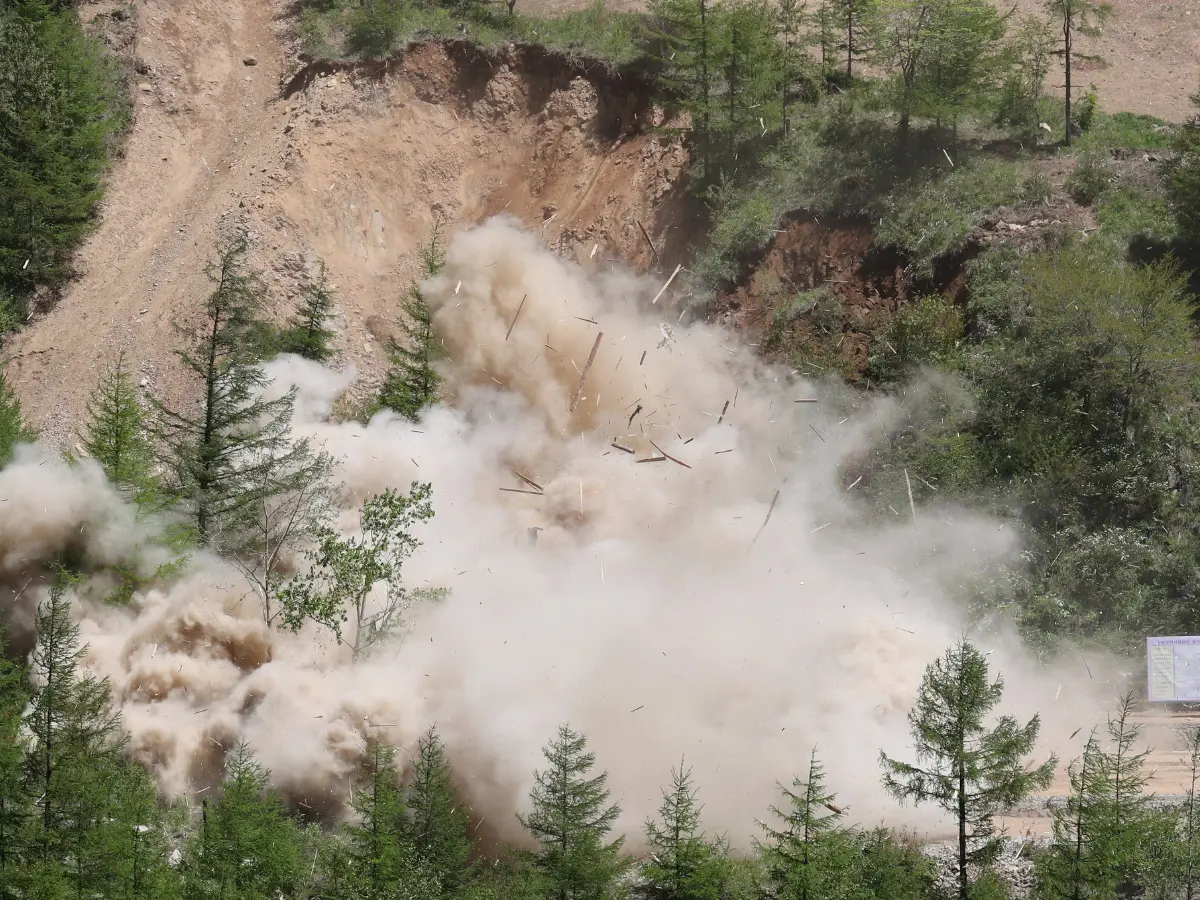
North Korea’s nuclear tests set off a chain of earthquakes that continue to shake the ground even today, years after the last test in a mountain region. They are not slowing down or falling in number and are instead becoming more intense, creating a puzzle.
A study has found that North Korean nuclear tests reactivated fault lines that had been quiet for a long time. This triggered hundreds of earthquakes that kept getting stronger, even years after its last test in 2017. Under Mount Mantap, the country detonated six nuclear devices between 2006 and 2017. Nuclear tests send reverberations through the ground, but in this case, they weren’t temporary.
Seismologist Kwang-Hee Kim of Pusan National University in South Korea told ScienceAlert that earthquakes after underground nuclear tests are not the surprising thing here, but how the seismicity evolved. “Instead of being strongest immediately after the explosion and then fading, the activity increased over several years,” he said.
North Korea’s Punggye-ri nuclear test site sits under the 7,234-foot Mount Mantap. The first test happened in October 2006, and the last one came on 3 September 2017, which was the largest of all. It unleashed an estimated 100 to 250 kilotons of energy, enough to trigger a 6.3 magnitude earthquake.
Such an explosion likely carved an underground cavity and sent intense stresses through the rock. It is believed to have crashed after cooling down just 8.5 minutes after the explosion. Experts point to the detection of a magnitude 4.1 seismic event at the time as proof.
The test was over, and the cavity had collapsed. North Korea was not testing any more weapons. The earthquakes from Punggye-ri should have also slowly ebbed. However, more unexplained seismic activity was recorded three weeks later.
Kim said, “The sustained tectonic seismicity began about 20 days later and then intensified over the following years.” Scientists went through 17 years of seismic data recorded by stations in China and South Korea between 2008 and 2025.
Using a technique called matched-filter detection, they stumbled upon 1,399 tiny earthquakes which had been missed all this time. To figure out whether they had occurred from natural processes, the researchers gathered historical records on earthquakes in Mount Mantap, which isn’t seismically active. They found almost nothing despite going back hundreds of years, barring a 6.7 magnitude quake in 1810 around 100 kilometres from the area. A few local events also happened after the 2013 nuclear test.
The silence was ultimately broken on September 23, 2017. Several earthquakes were recorded in the following months, and continued to intensify instead of showing a drop.
A total of 955 of the earthquakes were precisely traced to various locations, which mapped out two roughly parallel structures running north-northwest from the test site. This pattern showed that the tests had disturbed old weaknesses in the crust. To answer why the ground was still shaking years after the last test, the team inferred “that the repeated tests altered the mechanical balance of a heterogeneous crust that was already close to failure.”
The repeated explosions continued to have cumulative effects that caused earthquakes several kilometres away, which intensified years later. Kim added that the topography of Mount Mantap created variations in the stresses that were already affecting the shallow crust. So can a bigger earthquake happen one day?
Researchers say theoretically this action could produce an earthquake of around magnitude 6.4, although this is merely a hypothesis. The finding shows that how underground nuclear tests affect the geology needs to be studied for much longer. The main problem is distinguishing between a natural earthquake and one that happens from nuclear testing.
Original Source: WION