

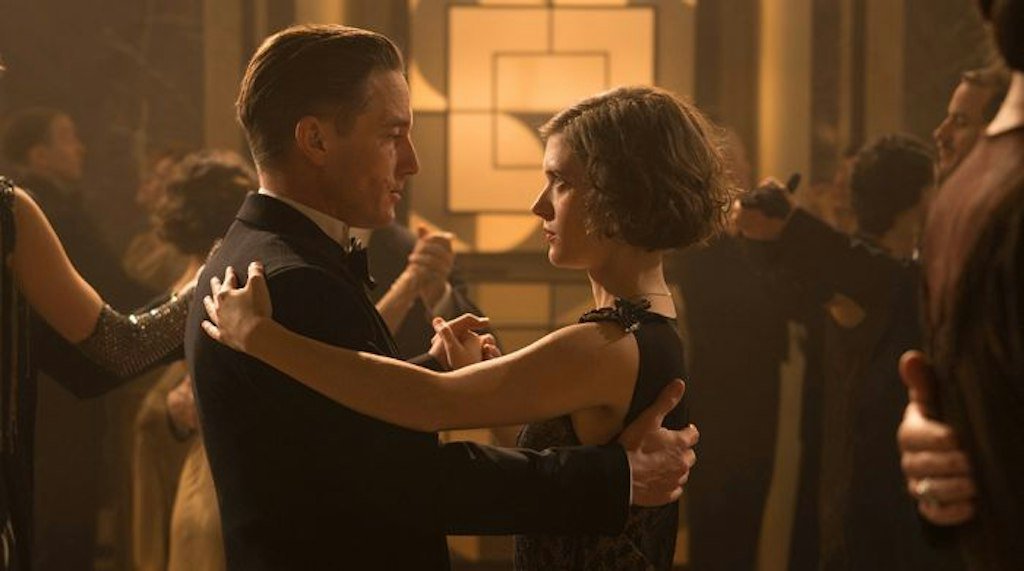
Berlin, 1933: Hitler becomes Reich Chancellor, the Nazis are consolidating their power — and right in the middle of it all, police officer Gereon Rath (Volker Bruch) and aspiring detective Charlotte Ritter (Liv Lisa Fries) are fighting for their futures. The final season of “Babylon Berlin” is set in a Germany undergoing radical upheaval.
When Tom Tykwer, Achim von Borries, and Henk Handloegten began the series in 2013, the world looked different: The AfD was a minor party, Donald Trump was not yet U.S. president, and Brexit was not yet an issue. More than ten years later, they tell the story of the rise of the National Socialists — in a changed political landscape.
In an interview with blue News, directors and writers Tom Tykwer and Achim von Borries discuss how this shapes their perspective on “Babylon Berlin” and how they brought 1933 Berlin back to life.
The first 16 episodes, which were produced together as the first and second seasons, cost just under 40 million euros — about 2.5 million euros per episode. This earned “Babylon Berlin” a reputation at times as the most expensive series in the world, according to the German media magazine “dwdl”.
Von Borries puts it into perspective: “It certainly wasn’t the most expensive series of all time.” By international standards, he says, production costs were actually “extremely low.” “Modern Family” has a larger budget per episode, says Achim von Borries, film director and screenwriter of “Babylon Berlin.”
The key was to distribute the available funds across the entire production: “We took great care to invest equally in all areas of a production like this.”
Berlin: City of Dreamers and Proletarians
It was particularly challenging to recreate the Berlin of that era as authentically as possible. “Of course, we only shoot a fraction of it in the studio. We actually go to the original locations and then have to redecorate them or digitally reconstruct them. But we really do go into the city. We blocked down downtown Berlin with all of our hundreds of people.”
The filmmakers did not want to tell the story from the perspective of those in power, but rather from that of the people who have to live with the consequences of political upheavals. The protagonists did not belong to the political or social elite; rather, they were “among the people” and experienced “this massive paradigm shift firsthand.”
Berlin has always been a “proletarian city” and a “city of social climbers and dreams,” says von Borries. For this reason, the story of Charlotte Ritter (Liv Lisa Fries) in particular was deliberately crafted as a rags-to-riches tale — the story of a woman who comes from “incredibly poor and working-class Berlin.” The series aimed to show this world “in all its grime and misery, but also in its beauty.”
The political changes since the series began have also changed the creators’ perspective on the material.
“When we started, it was a political period that was still much calmer. Europe was still much more stable. The AfD was a tiny fringe party,” says Tom Tykwer (“Run Lola Run”). The German filmmaker is considered the creative force behind the hit series. He is a screenwriter, director, and film composer. Tykwer continues: “Back when we started writing — that was in 2013. It’s hard to even imagine that now.”
Back then, there was no Donald Trump and no Brexit yet. Many issues “that have now contributed to the destabilization of the world” hadn’t yet come into play. While “Babylon Berlin” was in production over the course of several years, the political situation became “gradually more complicated.”
Tykwer deliberately avoids referring to Hitler’s “seizure of power” and instead speaks of a “transfer of power”: “Because we also describe it in such a way that there were plenty of enablers.” By this, he means political and social actors who paved the way for Hitler to come to power. The series aims to shed light on at least some of the mechanisms that made this development possible.
The historical outcome is well known. Nevertheless, the finale should not be told as a story of the Nazis’ triumph. Tykwer puts the goal for the final season differently: “We want to tell it as a struggle for democracy, not as a drama about the rise of the anti-democrats.”
Original Source: www.Bluewin.ch